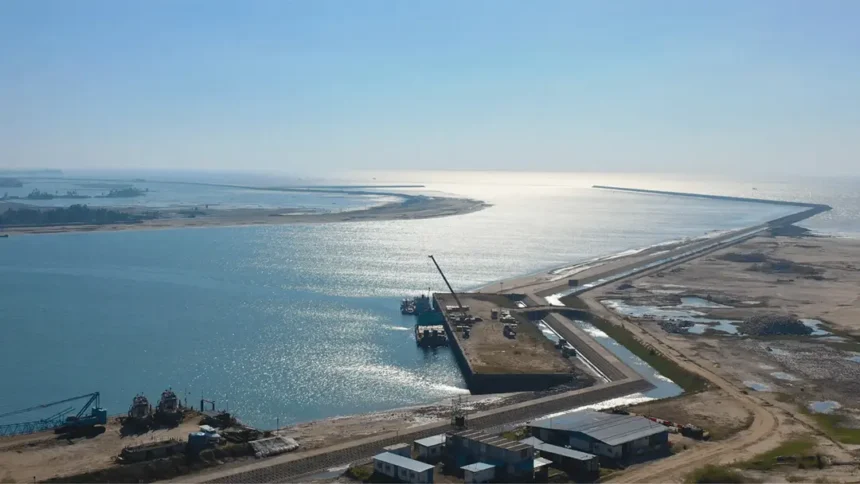
Japan is planning to develop a special industrial value chain centred on Bangladesh’s Matarbari deep-sea port, linking the strategically important port with India’s northeastern states and strengthening regional trade and connectivity.
The initiative comes ahead of Prime Minister Tarique Rahman’s scheduled visit to Japan on October 26, during which Bangladesh may seek Japanese financial assistance for several infrastructure and industrial development projects, according to a report by Indian newspaper The Hindu, citing diplomatic sources in Tokyo.
A senior Japanese diplomatic representative told The Hindu in an exclusive interview that the Matarbari deep-sea port could transform Bangladesh into a regional industrial hub while giving fresh momentum to regional connectivity and transit arrangements.
According to the report, Prime Minister Tarique Rahman may seek Japanese financial assistance for projects related to the Matarbari industrial, port and commercial hub through 2031. As part of the preparations, he visited Matarbari in August and was briefed on the project’s requirements and subsequent development needs.
Once fully operational, Matarbari will be Bangladesh’s only deep-sea port, potentially reducing the country’s dependence on foreign ports for handling large cargo vessels. Bangladesh currently relies on ports in Colombo, Singapore and Malaysia for the transshipment of goods carried by large ships.
Under Japan’s proposed plan, Matarbari would serve as a key component of an industrial value chain connecting India’s seven northeastern states, commonly known as the Seven Sisters, with the Bay of Bengal and Southeast Asian countries through Bangladesh.
Japan is looking to replicate the success of a similar industrial development corridor connecting Bangkok with Cambodia and Vietnam, which received Japanese financial and infrastructure support.
In a written response to The Hindu, the Japanese official identified Bangkok as a potential model for Bangladesh, noting that the Thai capital had played a leading role in regional economic growth by leveraging its ports and the Southern Economic Corridor.
Japanese diplomats view the proposed Matarbari-centred initiative as an opportunity to strengthen direct road and trade links among Bangladesh, India, Nepal, Bhutan and Myanmar, while expanding economic integration across the wider region.
The Matarbari deep-sea port has received financial support from the Japan International Cooperation Agency (JICA). A substantial portion of the project’s development work took place during the tenure of the previous government led by Sheikh Hasina.
The Hindu report noted that the initiative had been facilitated by the relatively close relations between India and Bangladesh at the time, which helped create favourable conditions for regional connectivity projects.
One such initiative was the construction of the Maitri Setu, or Friendship Bridge, over the Feni River, connecting Tripura in northeastern India with Bangladesh. The bridge was intended to facilitate direct access to Chattogram and the Matarbari port for India’s northeastern region.
However, subsequent strains in bilateral relations have prevented the bridge from becoming fully operational for the intended connectivity arrangements, according to the report.
Despite the challenges, Japanese officials remain optimistic about the long-term prospects of Bangladesh-India relations and the broader regional connectivity agenda.
They believe that expanding transport and trade links between Bangladesh, India’s northeastern states and neighbouring countries would significantly enhance the strategic and economic value of the Matarbari deep-sea port.
The proposed industrial value chain could position Bangladesh as an important regional gateway for trade, logistics and industrial investment, while opening new opportunities for cross-border commerce and supply-chain integration across South and Southeast Asia.
Prime Minister Tarique Rahman’s upcoming visit to Japan is therefore expected to provide an opportunity to discuss the next phase of Japanese-backed infrastructure development and the potential for deeper regional economic cooperation.