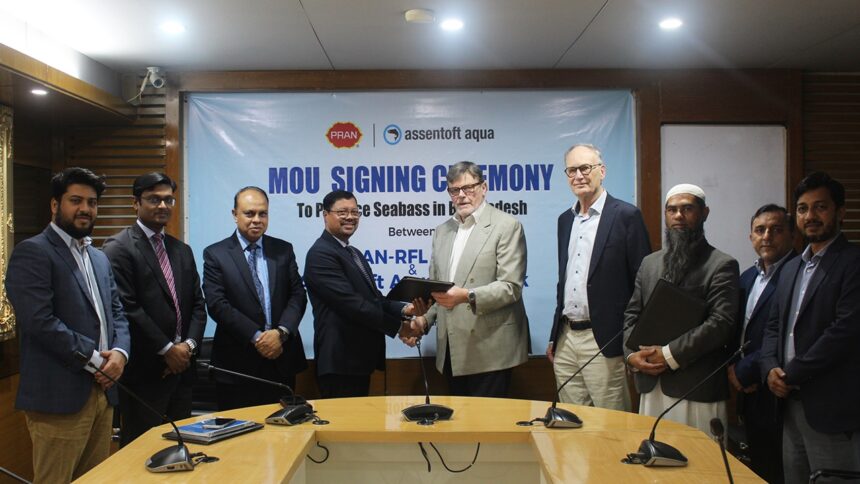
Hobiganj Agro Limited, a subsidiary of the country’s leading industrial conglomerate PRAN-RFL Group, has signed a Memorandum of Understanding (MoU) with the Danish firm Assentoft Aqua to establish a state-of-the-art, indoor intensive fish farming project.
The collaboration will utilize advanced Recirculating Aquaculture System (RAS) technology to create a fully controlled environment for high-value marine fish production—a first for industrial-scale seabass and hilsa farming in Bangladesh.
Project Overview and Investment
The agreement was signed on Thursday, January 22, at the PRAN-RFL Group headquarters in Badda, Dhaka. Key details of the venture include:
-
Total Investment: €30 Million (approx. Tk 430 crore) to be deployed in 2–3 phases over the next two years.
-
Financing: Supported by Danish government-guaranteed funding.
-
Location: Planned for the Mirsarai Economic Zone in Chattogram or another mutually agreed site.
-
Production Goal: Approximately 2,000 metric tons of fish per year upon full implementation.
Focus on High-Value Marine Species
The project aims to meet the rising domestic and international demand for premium marine fish. The facility will primarily culture:
-
Asian Seabass (Vetki/Koral)
-
Grouper (Seba/Koral variety)
-
Hilsa (the national fish of Bangladesh)
The target weight for the fish will be between 1,200g and 1,500g. While a portion will be sold in the local market, a significant share is intended for the export market, boosting Bangladesh’s foreign exchange earnings.
Leadership Perspectives
Eleash Mridha, Managing Director of PRAN Group, highlighted the significance of the move:
“PRAN Group is committed to bringing sophisticated RAS technology to Bangladesh to meet the growing demand for delicious marine fish. This partnership with Assentoft Aqua is a vital step toward producing high-yield, premium-quality fish at an industrial scale.”
Dr. Jens Ole Olesen, Business Development Director at Assentoft Aqua, expressed optimism:
“We have already secured Danish government-guaranteed financing for this RAS project. Our goal is to establish a comprehensive facility including a hatchery, nursery, and broodstock management to ensure sustainable production of tasty marine fish.”
What is RAS Technology?
The Recirculating Aquaculture System (RAS) is a cutting-edge technology that allows fish to be farmed in high densities indoors. Key benefits include:
-
Water Conservation: Recycles up to 99% of the water used.
-
Total Control: Enables precise management of water temperature, oxygen levels, and salinity.
-
Biosecurity: Minimizes the risk of disease and external parasites compared to open-pond farming.
-
Year-Round Production: Allows for consistent harvesting regardless of weather or season.