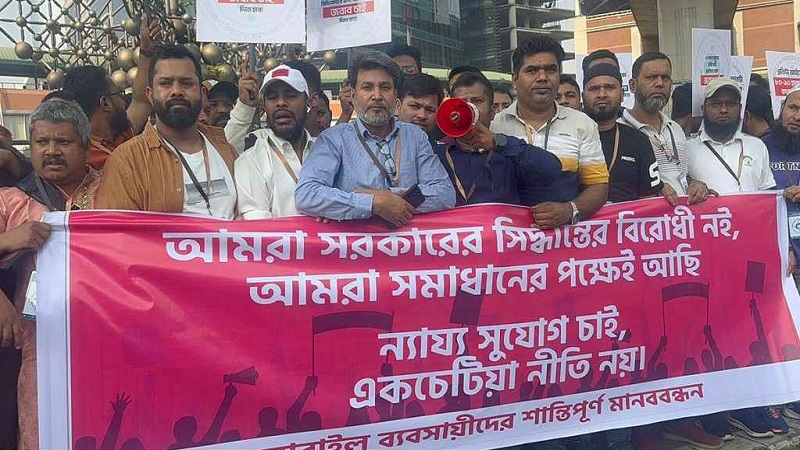
The Mobile Business Community Bangladesh (MBCB), a national platform of smartphone and gadget traders, has urged the government to sit with mobile phone businesses before implementing the National Equipment Identity Register (NEIR). They made the call during a peaceful human chain organised in the Karwan Bazar–Panthapath area of the capital on Sunday (30 November).
At the event, speakers said that more than 70 percent of the country’s mobile phone market is run by traders like them, yet the authorities are moving towards enforcing NEIR without any discussion with stakeholders. “We are not against NEIR,” they said. “However, some reforms in the process, a fair tax policy, elimination of monopolistic syndicates, and equal opportunities for all traders must be ensured. We want to present our concerns and proposals to the government, but the authorities are proceeding unilaterally without listening to tens of thousands of traders.”
Market instability and threat to livelihoods
Trader leaders alleged that the sudden announcement of enforcing NEIR without prior consultation has created extreme instability in the market. As a result, around 25,000 businesses and more than 2 million people involved in the sector are at risk.
They added, “We run our businesses legally and have taken hundreds of crores in bank loans. We currently have huge stocks of mobile handsets worth crores of taka. It is impossible to sell these by 16 December. If a handful of companies are favored while our demands are ignored, we will be forced onto the streets.”
The leaders warned that if the government does not engage in dialogue before NEIR is implemented, mobile traders across the country will gather in Dhaka and launch a large-scale protest movement.
Concerns over monopoly and unrealistic policy
According to MBCB, under the current structure of NEIR, legal import of mobile phones will become nearly impossible—whether the duty is 57 percent or zero percent.
They pointed out that the BTRC import policy states:
If a foreign brand assembles its products locally, no other importer may bring in any model of that brand.
Traders argue that this policy creates a monopoly and hands over the 18-crore mobile phone market to a few companies. This would destroy existing competition, sharply increase smartphone prices, and ultimately harm consumers. Additionally, they warned that such a scenario could hinder the country’s digital progress.
Key proposals submitted to the government
During the human chain, MBCB presented several specific proposals to ensure stability in the mobile phone sector:
- Abolish the mandatory agreement with manufacturers
- Allow automatic handset registration upon submission of the Bill of Entry
- Formulate a policy or provide extra time to sell the large volume of unsold stock
- Reduce the current 57% duty on imported foreign handsets to a reasonable level
- Prohibit local assemblers from engaging in retail or direct consumer-level sales
- Operate NEIR under the involvement of multiple ministries for balanced oversight
- Develop research-based and practical policies that reflect market realities
Leaders of MBCB’s central committee, along with owners and employees of various markets in Dhaka, attended the human chain. As part of the movement, all mobile phone shops across the country remained closed the previous day (Saturday). Traders in divisional cities, districts, and upazilas also held similar peaceful demonstrations pressing the same demands.