Central Bank Governor Dr. Ahsan H. Mansur stated on Saturday that while Islamic banks in Bangladesh remain competitive and capable of offering satisfactory returns, a severe lack of good governance has allowed certain individuals and institutions to plunder massive amounts of wealth from the sector.
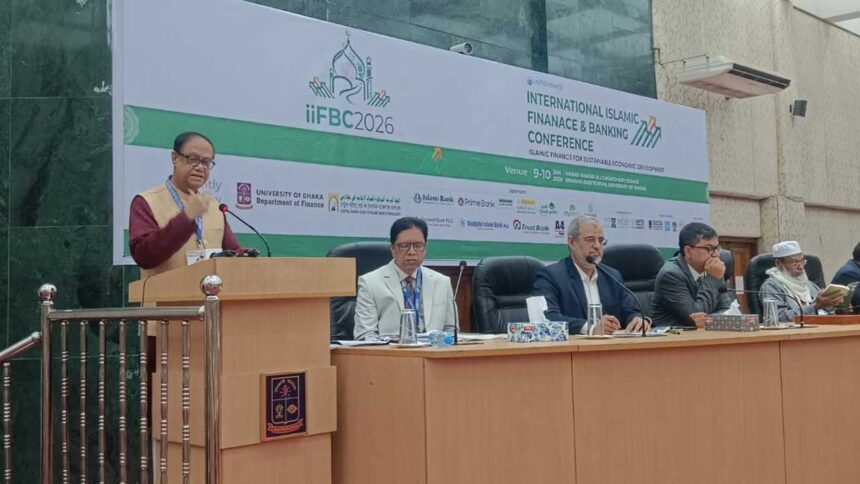
Speaking as the chief guest on the second day of the “International Islamic Finance and Banking Conference” at Dhaka University, the Governor highlighted a stark contrast between the theoretical safety of Islamic banking and the recent reality in Bangladesh.
Structural Failures and “Lootocracy”
Dr. Mansur noted that by principle, Islamic banking is considered one of the safest lending systems because it is directly linked to physical assets and real income. However, he lamented that the failure to implement these principles correctly, coupled with “takeovers” by certain groups, created opportunities for widespread irregularities.
“The responsibility for these irregularities does not lie with a single party,” the Governor remarked. “The situation became complex because the regulatory body, bank management, and Shariah boards failed to perform their respective duties. Simultaneously, depositors did not ask enough questions about where and how their money was being spent.”
He asserted a firm stance against future corruption, stating, “Financial ‘lootocracy’ (lut-tontro) will not be allowed to return to Bangladesh.”
A Pillar of the Economy
Despite the challenges, Dr. Mansur emphasized that Islamic banking is not merely a matter of religious sentiment but a comprehensive economic system. Currently, Islamic banks hold more than a quarter of the country’s total banking market share.
“In Bangladesh, Islamic banking is the result of the conscious choice of the people,” he said, expressing hope that the sector would expand further. He noted that public trust remains resilient, highlighting that Islamic banks received the highest volume of deposits over the past year. Furthermore, Islami Bank Bangladesh PLC has recently begun repaying liquidity support taken from the central bank.
Strategic Reforms and the Path Forward
To address liquidity management issues and limited investment avenues for Shariah-based banks, the Governor stressed the urgent need to develop a robust Sukuk (Islamic bond) market.
To restore stability and trust, the central bank has already taken several drastic measures:
-
Mergers: Five banks have recently been merged to strengthen the sector.
-
Board Reconstruction: The Board of Directors of the country’s largest Islamic bank has been reconstituted.
-
New Legislation: A new Islamic Banking Act is currently being drafted to ensure transparency in loan disbursement.
-
Strengthening Shariah Boards: Dr. Mansur called for Shariah boards to be more courageous. “Members of the board cannot afford to fear for their jobs if they are to ensure compliance,” he added.
The Governor concluded by stating that the primary challenge now is to ensure transparency and a strong regulatory framework to make Bangladesh’s Islamic banking sector a global model.
The two-day conference was jointly organized by the Central Shariah Board for Islamic Banks of Bangladesh and the Department of Finance at Dhaka University.