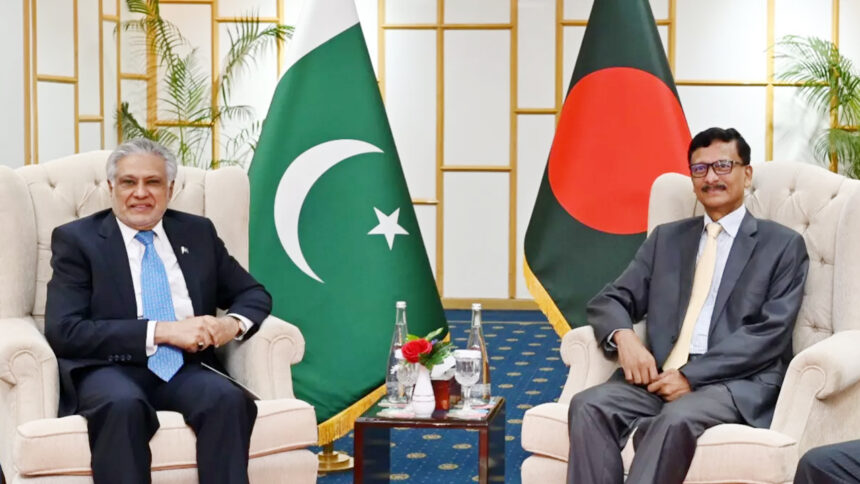
Pakistan’s Deputy Prime Minister Ishaq Dar has proposed the expansion of a nascent trilateral “alliance” involving Pakistan, Bangladesh, and China, suggesting that other countries, both regional and non-regional, could be included. Dar made the remarks during the Islamabad Conclave Forum on Wednesday (December 3), emphasizing cooperation over conflict.
“We are against gaining at the expense of others. We have always stressed cooperation instead of conflict,” Dar stated, hinting at a potential alternative mechanism to the South Asian Association for Regional Cooperation (SAARC), which has been largely paralyzed due to tensions between India and Pakistan.
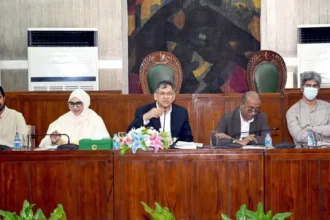
The proposal follows a trilateral meeting in June between diplomats from China, Pakistan, and Bangladesh, where discussions focused on regional stability, economic development, and improving the lives of people. At the time, it was stated that the talks were not “directed against any third country.”
Dar’s comments come amid heightened regional tensions, including the long-standing rivalry between India and Pakistan, who engaged in a four-day conflict in May. Furthermore, relations between Bangladesh and India have deteriorated following last year’s mass movement, particularly over New Delhi’s decision to shelter the now-exiled former dictator Sheikh Hasina. Hasina was sentenced to death last month for crimes against humanity, but India has so far refused to extradite her.
A Vision for a New Regional Order
Speaking at the forum, Dar said, “Our own national development needs and regional priorities should never be held hostage to anyone’s inflexibility. You know who I am talking about (India).”
Highlighting the eleven-year deadlock in dialogue between India and Pakistan, and the “volatile” relations between India and several other South Asian neighbors, Dar articulated a vision for South Asia “where cooperation and connectivity replace division, economic development takes place, conflicts are peacefully resolved, and peace is maintained with respect and dignity.”
However, Rabia Akhtar, an academic at Lahore University, described the Deputy Prime Minister’s optimism as “more aspirational than realistic at this moment.” She noted that the move signals Pakistan’s desire to “diversify the mechanisms of regional cooperation” given SAARC’s current ineffectiveness.
The Failure of SAARC
SAARC was established in 1985 in Dhaka with Bangladesh, Bhutan, India, Nepal, Pakistan, and Sri Lanka as founding members, and Afghanistan joining in 2007. Its goal was to foster regional ties and development across economic and cultural spheres. Yet, over 40 years, the organization has largely failed to meet its objectives, primarily due to the hostile relationship between India and Pakistan.
The 19th SAARC summit, scheduled for Islamabad in 2016, was indefinitely suspended after India pulled out following a major attack in Indian-controlled Kashmir, which it blamed on Pakistan. No SAARC summit has been held since.
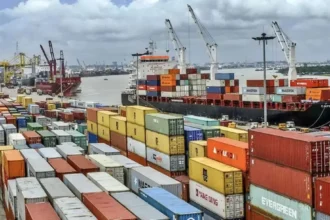
SAARC is critical because South Asia, home to over 2 billion people, remains one of the least integrated regions economically. Trade among SAARC nations accounts for only five percent (around $23 billion) of the region’s total international trade. By contrast, the 11-member ASEAN bloc, with a population of 700 million, conducts 25 percent of its international trade internally. The World Bank estimates that removing existing barriers could unlock up to $67 billion in internal trade.
Trade between India and Pakistan is particularly low, with only $1.2 billion in direct trade in 2024, although indirect trade is estimated at about $10 billion.
Prospects of Pakistan’s Proposal
Pakistan is not the first to attempt bypassing SAARC. Failed attempts at regional cooperation have led to the creation of the BBIN (Bangladesh, Bhutan, India, and Nepal) and BIMSTEC (Bangladesh, Bhutan, Myanmar, Nepal, Sri Lanka, and Thailand) alliances.
Shabab Enam Khan of the Bangladesh Centre for Indo-Pacific Affairs told Al Jazeera, “Pakistan’s proposal, though ambitious, is very necessary.” He lamented that South Asia has repeatedly failed to achieve meaningful regional cooperation, “trapped in security-centric thinking or perhaps a lack of political foresight.”
Praveen Donthi, a senior analyst with the International Crisis Group, believes that in theory, there is room for a new regional bloc. “SAARC’s quiet demise due to poor India-Pakistan relations creates a vacuum for another bloc in South Asia,” he said. He added that the deteriorating relationship between Bangladesh and India, coupled with improved ties with Pakistan, paves the way for trilateral cooperation with China.
Whether Pakistan’s proposal will succeed remains to be seen. Rabia Akhtar notes that potential states will first assess if they see “practical relevance” in small, issue-specific groups, and secondly, if participation would create a “political problem or cost with India.” She suggests that while other South Asian nations might show interest, their likelihood of formally joining is limited.
Donthi cautioned that the success of Pakistan’s proposal would likely further strain India-Bangladesh relations and intensify the India-China rivalry.