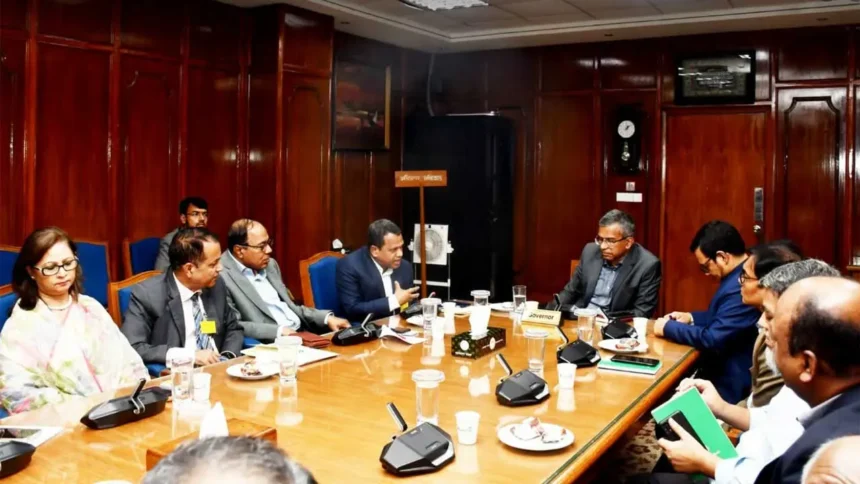
A high-level delegation from the Federation of Bangladesh Chambers of Commerce and Industry (FBCCI) met with Bangladesh Bank Governor Md. Mostakur Rahman on Monday, April 6, 2026, to submit a series of proposals aimed at stabilizing the economy and easing the liquidity crunch facing the private sector.
The business leaders placed several key demands before the central bank, including bringing interest rates back down to a single-digit figure, increasing the size of the Export Development Fund (EDF), and simplifying loan procedures to ensure a steady flow of credit to businesses.
Restoring the Export Development Fund (EDF)
A primary concern raised during the meeting was the drastic reduction of the EDF. FBCCI Secretary General Md. Alamgir noted that the fund, which previously stood at $7 billion, has shrunk to $2.3 billion.
Despite IMF conditions regarding the use of foreign exchange reserves, the FBCCI urged the Governor to increase the EDF to $5 billion to insulate the export sector from potential shocks caused by Middle East tensions. The Governor reportedly assured the leaders that the fund would be increased gradually.
Demand for Credit Expansion and Interest Rate Cuts
The business community expressed deep concern over the rising cost of borrowing. Taskeen Ahmed, President of the Dhaka Chamber of Commerce and Industry (DCCI), highlighted that the policy rate currently stands at 10%, pushing lending rates as high as 16-17%.
“Private sector credit growth has plummeted to 6.3%, the lowest in 22 years,” Ahmed stated, emphasizing the urgent need for a more accommodative monetary policy.
Key policy proposals submitted by the FBCCI include:
-
Single-Digit Interest Rates: Reducing borrowing costs to stimulate production.
-
Single Borrower Limit: Increasing the limit from 15% to 25% of a bank’s paid-up capital.
-
Default Loan Rehabilitation: Providing policy support for “unintentional” defaulters affected by global economic volatility, while maintaining a strict stance against “willful” defaulters.
Addressing the Banking Sector Crisis
The meeting comes at a time when the banking sector is struggling with soaring Non-Performing Loans (NPLs), which have exceeded 45% in some instances, with certain banks reporting NPLs as high as 90%.
The FBCCI underscored that while they do not support those who intentionally evade repayment, those who defaulted due to genuine business risks need a path toward rehabilitation to rejoin economic activities. They also called for:
-
Strengthening corporate governance in banks.
-
Recovering laundered money from abroad.
-
Ensuring the safety of depositors’ funds in banks undergoing mergers.
Governor’s Response
Governor Md. Mostakur Rahman acknowledged the challenges, noting that the economy has become overly reliant on a few specific products and export markets. He emphasized that the path to recovery lies in expanding internal economic activities, with a focus on Cottage, Small, and Medium Enterprises (CSMEs) and agriculture to drive local momentum and job creation.
The delegation included prominent leaders from various sectors, including representatives from BGMEA, BKMEA, BTMA, and various regional chambers, all echoing the need for a “business-friendly” policy environment to navigate the current economic headwinds.