Bangladesh has the potential to generate nearly $12 billion in annual export earnings from the leather sector if the industry is properly modernised and upgraded to meet international standards, Industries, Commerce, and Jute and Textiles Adviser Khandaker Abdul Moktadir has said.
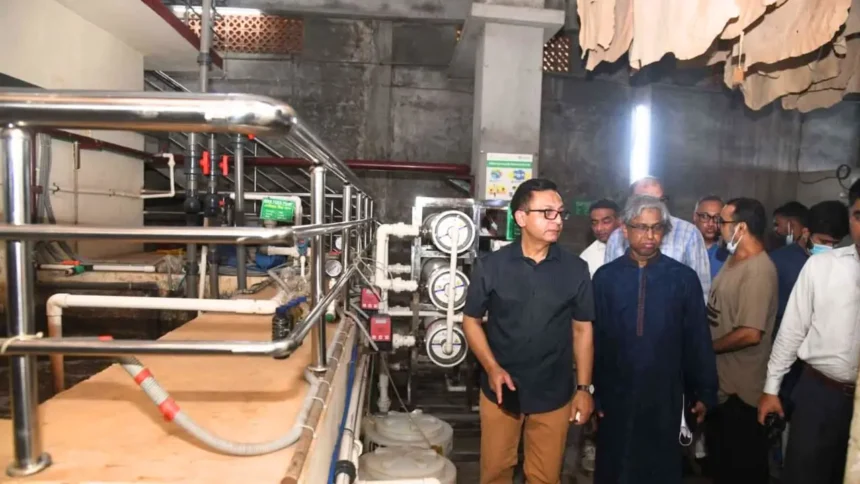
The adviser made the remarks while speaking to journalists after visiting the Central Effluent Treatment Plant (CETP) at the BSCIC Leather Industrial Estate in Savar on Friday.
He said the government is giving the highest priority to boosting leather and leather goods exports and is working to address long-standing challenges facing the sector.
“The leather industry remains one of the country’s most promising export sectors. With proper processing facilities, modern technology and compliance with international environmental standards, Bangladesh can significantly increase its leather exports and earn up to $12 billion annually,” he said.
Moktadir noted that the decision to relocate tanneries from Dhaka’s Hazaribagh area to Savar was fundamentally correct, as tannery operations generate large volumes of industrial waste and require access to modern waste treatment facilities.
However, he acknowledged that the relocation process had been poorly planned and inadequately implemented.
“The relocation itself was a necessary step, but the process suffered from negligence and a lack of proper planning. As a result, the leather sector has not achieved its desired goals, and many industrial units have disappeared along the way,” he said.
The adviser also revealed that the government is considering involving Italy in the operation and development of the Central Effluent Treatment Plant to improve environmental compliance and maintain international standards.
He said the government is actively working to strengthen pollution control measures and ensure sustainable development of the leather industry.
According to the adviser, the CETP was designed to treat approximately 25,000 cubic metres of liquid waste per day. During peak production periods, however, waste generation rises to between 40,000 and 50,000 cubic metres daily, far exceeding the plant’s current treatment capacity.
To address the issue, the government is focusing on restoring the CETP to its planned operational capacity and improving chromium recovery systems used in tannery waste management.
Moktadir said authorities are also exploring ways to support financially distressed and closed industrial units so that they can resume operations and contribute to the sector’s growth.
Following the inspection of the CETP, the adviser visited several tannery facilities within the industrial estate, including headquarters and bay tannery units. He held discussions with factory owners regarding the current state of the industry, production challenges and environmental management practices.
Industries Ministry Secretary Md Obaidur Rahman, BSCIC Chairman Md Saiful Islam and other senior government officials were also present during the visit.
Bangladesh’s leather and leather goods sector is considered one of the country’s major export-oriented industries after garments. Industry stakeholders have long argued that improved environmental compliance, technological upgrades and stronger infrastructure are essential for unlocking the sector’s full export potential in global markets.