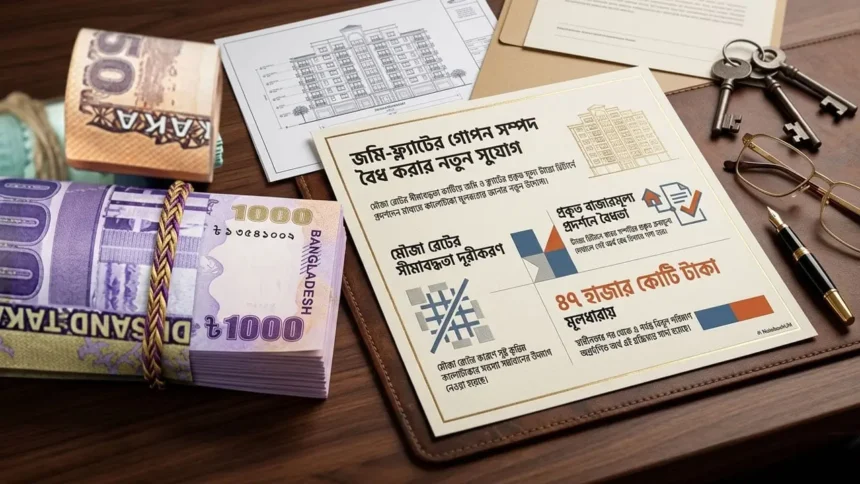
The Bangladesh government is considering a new mechanism in the proposed FY2026-27 national c to allow undisclosed money generated through property transactions to be legalized under strict conditions, according to officials familiar with the matter.
The initiative aims to address long-standing irregularities in the country’s real estate sector, where actual transaction values for land, flats, apartments, and commercial spaces are often significantly higher than officially recorded deed values.
Under the proposed framework, both buyers and sellers would be required to declare the actual transaction amount in their income tax returns. The undeclared portion could then be legitimized by paying taxes at the applicable regular income tax rate.
Officials say the move is intended not as a conventional “black money whitening” scheme, but as an attempt to correct distortions created by outdated government valuation systems and low “mouza” rates used for property registration.
How the Proposed System Would Work
For example, if a flat is sold for Tk 20 million but officially registered at a mouza value of Tk 6.5 million, the remaining Tk 13.5 million would remain undocumented under the current system.
Under the proposed measure, both parties would need to disclose the full Tk 20 million in their tax filings. The seller would then pay income tax on the undisclosed Tk 13.5 million according to existing tax slabs to legalize the amount.
A senior National Board of Revenue (NBR) official, speaking on condition of anonymity, said the government does not want to label the initiative as an opportunity to whiten black money.
“A flawed system has long encouraged underreporting in property transactions. Until the system is corrected, undisclosed money will continue to be created in this sector,” the official said.
Bangladesh’s Long History of Black Money Amnesty
Successive governments in Bangladesh have repeatedly offered opportunities to legalize undisclosed income since independence.
According to NBR data, more than Tk 47,000 crore in undisclosed money has been legalized over the years.
The highest amount was recorded during the Covid-19 pandemic in FY2020-21, when 11,839 individuals legalized nearly Tk 20,500 crore by paying a flat 10% tax. The government collected around Tk 2,064 crore in revenue from the scheme.
However, participation declined sharply in FY2021-22 after the benefits were reduced. Only 2,311 taxpayers legalized around Tk 1,663 crore that year.
The second-largest disclosure occurred during the military-backed caretaker government in FY2007-08 and FY2008-09, when Tk 9,683 crore was legalized by a record 32,558 individuals and businesses.
During the Awami League government’s three consecutive terms between 2009 and 2023, around Tk 33,000 crore was legalized, much of it during the pandemic-era scheme.
In FY2024-25, the government reintroduced the facility at a 15% tax rate. However, after the fall of the Awami League government, the interim administration gradually withdrew special immunity provisions linked to such schemes.
Currently, undisclosed income can still be declared legally, but taxpayers must pay the regular tax rate — up to 30% — along with a 10% penalty on the payable tax.
Economists Oppose Preferential Treatment
Economists have long criticized black money whitening facilities, arguing that they weaken tax morality and discourage honest taxpayers.
Distinguished Fellow of the Centre for Policy Dialogue (CPD), Professor Mustafizur Rahman, said such schemes create inequality within the tax system.
“The government may earn some additional revenue, but these facilities discourage honest taxpayers who regularly comply with tax rules,” he said. “If such a provision must exist, it should involve payment of the full applicable tax along with penalties.”
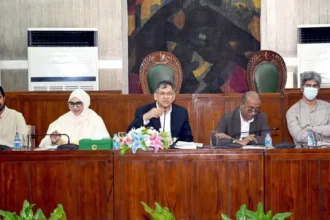
NBR Chairman Md Abdur Rahman Khan recently reiterated during pre-budget discussions that anyone can already disclose undeclared wealth by paying taxes under the existing legal framework without any special incentives.
“In the past 54-55 years, many special schemes were introduced, but most produced negative outcomes because compliant taxpayers viewed them unfairly,” he said.
Real Estate Sector Seeks Easier Terms
Meanwhile, the Real Estate and Housing Association of Bangladesh (REHAB) has again urged the government to allow investment of undisclosed money in the housing sector at lower tax rates and without questions regarding the source of funds.
In a written proposal submitted during pre-budget discussions on April 8, REHAB requested restoration of provisions preventing authorities from questioning the source of funds used to purchase apartments.
The organization argued that such a policy would boost investment in the struggling housing sector and help revive economic activity in real estate.