India’s Deputy High Commissioner to Bangladesh, Pawan Kumar Tulshidas Badhe, has emphasized the need to form a business-to-business (B2B) taskforce to enhance bilateral trade and investment between Bangladesh and India, while addressing tariff and non-tariff barriers.
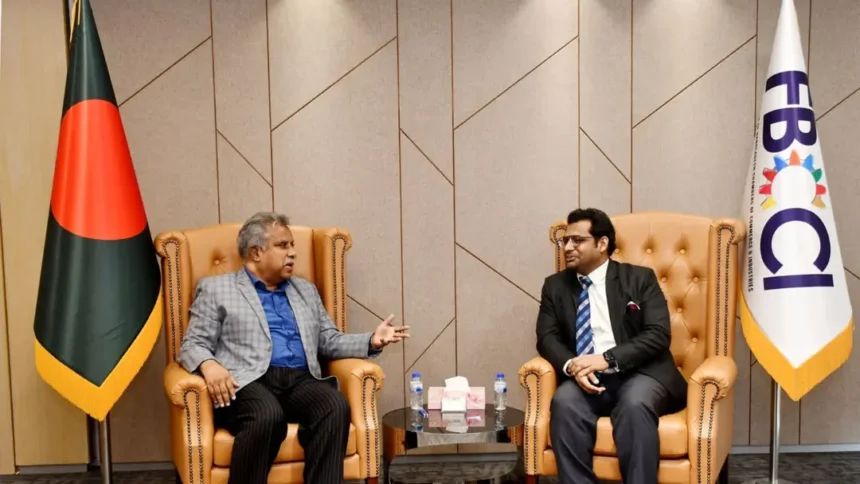
He made the remarks during a courtesy meeting with FBCCI Administrator Md. Fazlul Haque at the FBCCI office in Gulshan on Sunday.
During the meeting, the Deputy High Commissioner stressed the importance of expanding bilateral trade and investment, removing existing trade barriers, and strengthening commercial connectivity between the two neighboring countries.
Highlighting the role of private sector collaboration, he underscored the urgency of establishing a B2B taskforce to facilitate smoother trade relations. He added that his office has been maintaining regular communication with both governments to accelerate the process of forming the taskforce and sought active cooperation from Bangladesh’s private sector under the leadership of FBCCI.
Badhe also noted that visa procedures for Bangladeshi nationals traveling to India have been simplified. He said the Indian High Commission is currently issuing around 5,000 visas daily.
Trade Imbalance Persists
Despite growing economic ties, a significant trade imbalance remains between the two countries. In the fiscal year 2025–26, Bangladesh imported goods worth $10.96 billion from India, while its exports to India stood at $1.75 billion—resulting in a trade deficit of over $9 billion in India’s favor.
However, Bangladesh’s exports to India showed a positive trend in the current fiscal year. In the first two months of FY2026–27, exports rose by 7.67 percent year-on-year to reach $335.2 million.
According to official Indian data, India’s exports to Bangladesh stood at $9.73 billion until February of FY2025–26, while imports from Bangladesh totaled $1.62 billion. Total bilateral trade during that period amounted to $11.35 billion.
The FBCCI administrator expressed optimism that a joint taskforce could play an effective role in boosting bilateral trade and strengthening mutual cooperation. He also called on business leaders and entrepreneurs from both countries to work together to unlock opportunities in emerging and promising sectors.