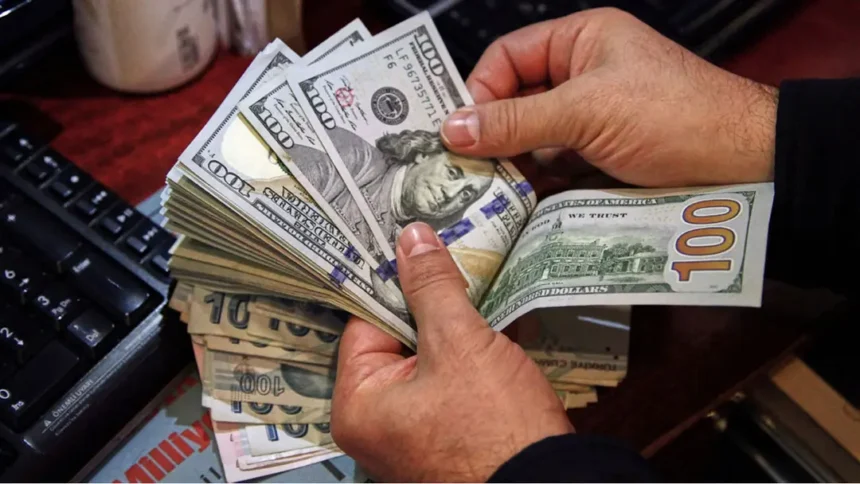
Relief has begun to return to the country’s foreign exchange market as the supply of US dollars normalizes relative to demand. As a result, dollar prices have decreased in both the interbank and commercial banking markets.
According to the latest data from Bangladesh Bank, the US dollar traded at Tk 122.63 in the interbank market on August 16. On the same day, the dollar was sold at Tk 123 in the spot market—down from Tk 123.82 recorded just a fortnight earlier.
Similarly, commercial banks are now settling international trade transactions and Letters of Credit (LC) liabilities at Tk 123.05 per dollar, compared to Tk 123.95 at the beginning of the month, reflecting a 90-paisa reduction per dollar over the course of a month.
Industry insiders attribute the stabilizing market conditions primarily to two factors: reduced import costs and robust remittance inflows.
During peak tensions and conflict in the Middle East, surging global oil prices had driven up Bangladesh’s import expenses for energy, fertilizer, and key commodities, sparking heightened dollar demand. Recent weeks, however, have seen a decline in large-scale import payment pressures. Concurrently, healthy remittance flows have sustained steady foreign currency supplies, restoring balance between supply and demand and driving down exchange rates.
According to Bangladesh Bank, expatriate Bangladeshis remitted nearly $1.5 billion ($150 crore) in the first 12 days of August—a 42% surge compared to the $1.05 billion ($105 crore) received during the corresponding period last year.
However, the drop in banking channel exchange rates has yet to extend to the kerb (open) market. On Sunday, money changers in the capital’s Motijheel area bought dollars from retail clients at Tk 126.60–126.70 and sold them at Tk 127.20–127.30 per dollar.