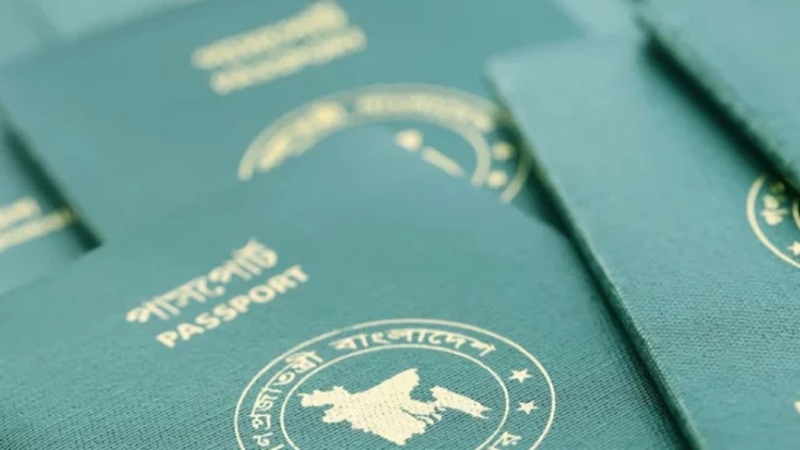
The government has taken an to introduce home delivery of passports to make citizen services easier, faster, and more modern, alongside a major modernization plan for the country’s immigration and visa system.
According to senior sources at the Ministry of Home Affairs Bangladesh and the Department of Immigration and Passports, a proposal has already been submitted for administrative approval to launch the home delivery service.
The initiative aims to reduce applicants’ travel time, costs, and hassles by enabling them to receive passports directly at their residences. To implement the plan, an estimated €870,000 (approximately Tk 123.7 million) will be required.
Under the proposal, €290,000 is expected to be allocated in the 2025–26 fiscal year, while the remaining €580,000 will be needed during the first two months (July–August) of the 2026–27 fiscal year.
Officials said the plan is currently under positive policy consideration. However, before implementation, administrative approval, budget allocation, secure distribution mechanisms, and technological capacity will need to be ensured.
As passports are highly sensitive state documents, the home delivery system will include strict identity verification, secure handover procedures, and digital tracking at every stage to prevent misuse.
A senior official of the ministry, speaking on condition of anonymity, said the initiative is part of a broader effort to make public services more citizen-friendly and efficient. “Once implemented, it will significantly reduce public suffering and improve service quality,” the official added.
Security analyst Colonel (Retd.) Kazi Sharif Uddin said the move is timely and necessary but stressed the importance of robust verification and secure chain-of-custody systems. “There must be no scope for passports to fall into the wrong hands,” he said, emphasizing digital tracking and identity checks.
Administrative law expert Barrister Zahid Rahman also termed the initiative a citizen-friendly step but highlighted the need for legal accountability, clear responsibility frameworks, and protection of personal data.
“It is not just a travel document; a passport is a sensitive state-issued identity. Therefore, proper recipient verification and record-keeping must be ensured at every stage of delivery,” he said.
Meanwhile, the government has also undertaken a major plan to modernize immigration and visa services. As part of this, the existing sticker visa system will be replaced with a state-of-the-art online visa system.
Relevant authorities have already planned to seek administrative approval and conduct pilot projects for the new system. The initiative is expected to facilitate foreign investors and travelers, contributing to socio-economic development and increased investment.
The proposal also includes the introduction of e-travel permits, enabling Bangladeshi citizens abroad without passports to return home on an emergency basis through Bangladesh missions.
To strengthen services, approval has been sought from the Ministry of Public Administration for creating 121 new positions in Bangladesh missions abroad. Additionally, the Department of Immigration and Passports plans to recruit technical and administrative personnel, including assistant directors, engineers, and programmers, to enhance internal efficiency.
A new Passport Processing Centre is also proposed in Gouripur, Cumilla, to ease pressure on the regional passport office and improve service delivery.
Furthermore, a budget of Tk 270 million has been proposed to modernize visa management systems in Bangladeshi missions abroad. Of this, Tk 240 million will be managed through inter-sectoral adjustments, while the remaining Tk 30 million will be covered through service charges and maintenance funds.
Experts believe that successful implementation of online visa services, e-travel permits, and skilled manpower deployment could significantly transform Bangladesh’s immigration system. However, they caution that strong legal frameworks, transparent administration, and adherence to international data protection standards will be crucial to fully realize the benefits of these modernization efforts.