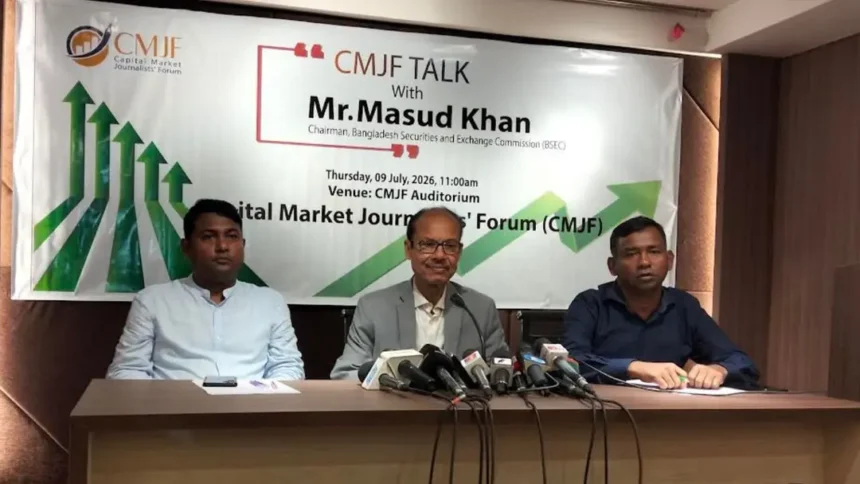
Bangladesh Securities and Exchange Commission (BSEC) Chairman Masood Khan has stated that the protection of shareholder interests in the five banks merged during the interim government must be guided strictly by international valuation methodologies.
Speaking on Thursday (July 9) at the “CMJF Talk” event—organized by the Capital Market Journalists Forum (CMJF) at Bijoynagar in the capital—the BSEC chief addressed pressing concerns regarding shareholder compensation and regulatory accountability. The session was conducted in the presence of CMJF President Monir Hossain, General Secretary Ahsan Habib Russell, and other association members.
The Debate Over Merged Bank Shares
During the interim government, five weak commercial banks were slated for merger, with their shares initially declared null or “zero.” Subsequent public and stakeholder criticism prompted former Finance Adviser Salehuddin Ahmed to announce that the government would explore compensation initiatives, leaving the calculation mechanism and ultimate payout pending for an extended period.
When questioned about how the current commission plans to safeguard the rights of these stranded shareholders, Chairman Khan reframed the issue through a fundamental economic lens.
“Before answering that, I want to raise a fundamental question: What is the value of this share? Did those five banks have negative net equity? The answer is yes—they were loss-making with negative equity. In these cases, what does international valuation methodology say? If a company is loss-making, we evaluate the share based on net worth and look no further. If net worth is negative, what is the valuation? The answer is zero.”
Khan further emphasized that investors bear accountability for market risks, noting that even if these banks had remained operational, their market pricing would have plummeted to fractional values due to prolonged underperformance and severe capital erosion.
Delisting Insolvent NBFIs and Defunct Firms
Addressing a second inquiry regarding the Dhaka Stock Exchange’s (DSE) recent initiatives to delist companies with long-suspended production activities, alongside Bangladesh Bank’s ongoing moves to liquidate distressed non-bank financial institutions (NBFIs), Khan maintained a consistent regulatory rationale.
When asked whether safeguarding small investors remains a priority during mass delistings, Khan offered a parallel assessment.
“You will receive the exact same answer. What is the condition of those institutions? The amount of negative equity in them is beyond calculation. What net worth do companies like International Leasing and Peoples Leasing possess? Their worth is far below zero.”
The BSEC leadership’s firm stance underscores an impending push for market transparency, signaling that regulatory frameworks will prioritize realistic asset evaluations over speculative recovery expectations for fundamentally insolvent entities.