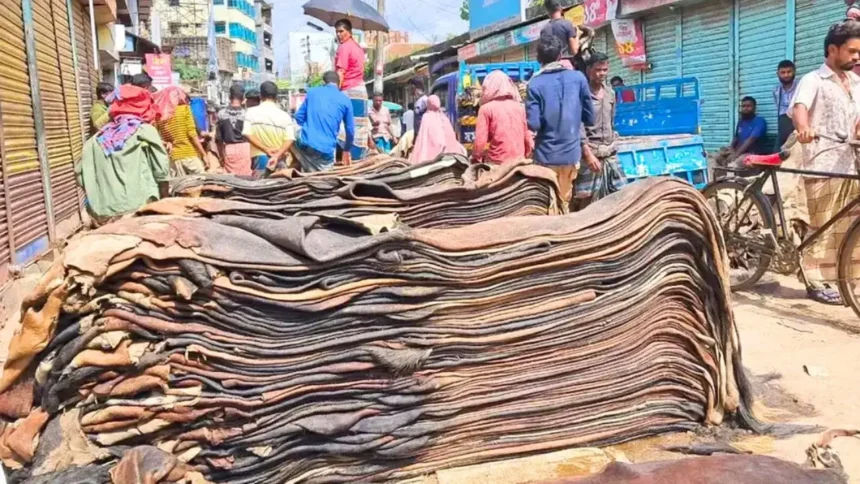
Dhaka, Bangladesh — Despite the government’s announcement of fixed prices for sacrificial animal hides during Eid-ul-Azha, the market has once again failed to reflect those rates, with rawhides selling at throwaway prices across the country. The situation has left seasonal traders facing heavy losses while depriving orphanages, madrasas and poor communities of a crucial source of annual income.
Every year, the hides of sacrificial animals become an important economic resource for religious institutions and charitable organizations. Many Bangladeshis donate hides to orphanages and madrasas, which then sell them to help finance food, education and operational expenses throughout the year. However, this year’s market collapse has significantly reduced those earnings.
Across Dhaka and other parts of the country, raw cattle hides were reportedly sold far below government-set prices. Traders said many hides fetched only a few hundred taka, while in some cases buyers could not be found at all. As a result, rawhides were seen discarded in dustbins, drains and open spaces in several areas of the capital.
Industry insiders allege that the rawhide market remains largely controlled by a powerful network of tannery owners and major wholesalers. Small-scale traders, dependent on these larger buyers, say they have little choice but to purchase hides at low prices and later sell them at even lower rates, often incurring losses.
“Eid-ul-Azha is usually a time when seasonal traders, orphanages and madrasas hope to earn some additional income,” said one trader. “But once again, those hopes have been shattered.”
The government had fixed the price of salted cowhide in Dhaka at Tk 62 to Tk 67 per square foot this year, an increase of Tk 2 from the previous year. However, traders say those prices existed only on paper. In practice, raw cattle hides were sold at rates significantly below the official benchmark, with many traders claiming prices were even lower than last year.
Residents also shared stories of poor demand. Hasanur Rahman, a resident of Moghbazar, said no buyers came forward to purchase hides from his family.
“We eventually donated the hide to a madrasa,” he said. “My uncle’s cow, which cost around Tk 270,000, had a hide that nobody wanted to buy. In Old Dhaka, my brother sold the hide of a Tk 143,000 cow for only Tk 300.”
Seasonal trader Jalal Uddin from Mugda said he bought small cattle hides for Tk 200 to Tk 300, medium-sized hides for Tk 300 to Tk 500 and large hides for Tk 500 to Tk 700. Even then, he said, he suffered losses when selling them to wholesalers.
“Many people called me to collect their hides, but I refused because there was no point in bringing them in and losing money,” he said.
Veteran trader Abul Hasan expressed frustration over the long-term decline of the industry.
“Twenty-five or thirty years ago, I sold a hide for Tk 2,800 to Tk 3,000. Today, a similar hide sells for only Tk 400 or Tk 500,” he said. “A Tk 400 hide cannot even cover labor costs. Who will stay in this business?”
He questioned why finished leather products continue to command high prices while rawhide prices remain depressed.
“Have leather shoe prices fallen? No. Then why are cattle hide prices so low? Either a syndicate is operating in the market, or there is a deliberate attempt to destroy this industry,” he added.
The impact has been particularly severe for orphanages and madrasas, many of which rely heavily on hide donations. Hafez Faizullah, a teacher at Jamia Qurania Madrasa and Orphanage in Dhaka, said students spent the entire day collecting hides from households across the city.
“Twenty madrasa students collected nearly 80 hides for the orphanage,” he said. “We sold all of them for only Tk 32,000. The effort of the entire day was almost wasted. That’s why we did not go out to collect hides again.”
Traders in Dhaka’s Posta rawhide market said hides brought in before evening were purchased for around Tk 500 to Tk 600 each. However, as the night progressed and hide quality began to deteriorate, prices dropped sharply, forcing sellers to accept much lower rates.
Tannery owners, however, have downplayed concerns. Sakhawat Ullah, Senior Vice Chairman of the Bangladesh Tanners Association (BTA), said isolated incidents occur every year and argued that overall management had improved compared to previous years.
“Based on the volume of hides collected so far, we believe the situation has been better managed than in recent years,” he said. “Until yesterday, hides were being purchased for Tk 600 to Tk 800. When the cost of salt and warehouse expenses is added, the price falls within the government’s prescribed range.”
Yet field-level traders and madrasa officials paint a different picture. They argue that although the government announces prices every year, there is little effective enforcement in the marketplace. Consequently, they say, the economic potential generated by Eid-ul-Azha continues to be captured by middlemen and influential business groups, while poor families, orphanages and small traders bear the brunt of the losses.
For many charitable institutions, the decline in hide prices represents more than a market problem. It directly affects the welfare of thousands of orphaned and underprivileged children who depend on those funds for their education, meals and daily care throughout the year.