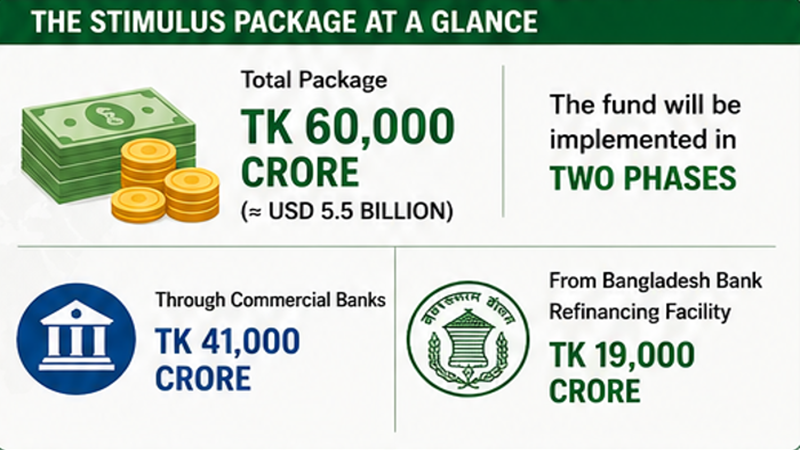
Bangladesh Bank has unveiled a sweeping stimulus package worth Tk 60,000 crore (approximately $5.5 billion) aimed at reviving economic momentum amid slowing GDP growth, stagnant investment, and a sharp decline in private sector credit flow.
Branded as the “Economic Recovery Program 2026,” the initiative targets key sectors including industry, agriculture, small and medium enterprises (CMSMEs), exports, and employment generation. Policymakers say the primary objective is to restore production capacity and stimulate new investment, although economists caution that success will depend heavily on implementation and oversight.
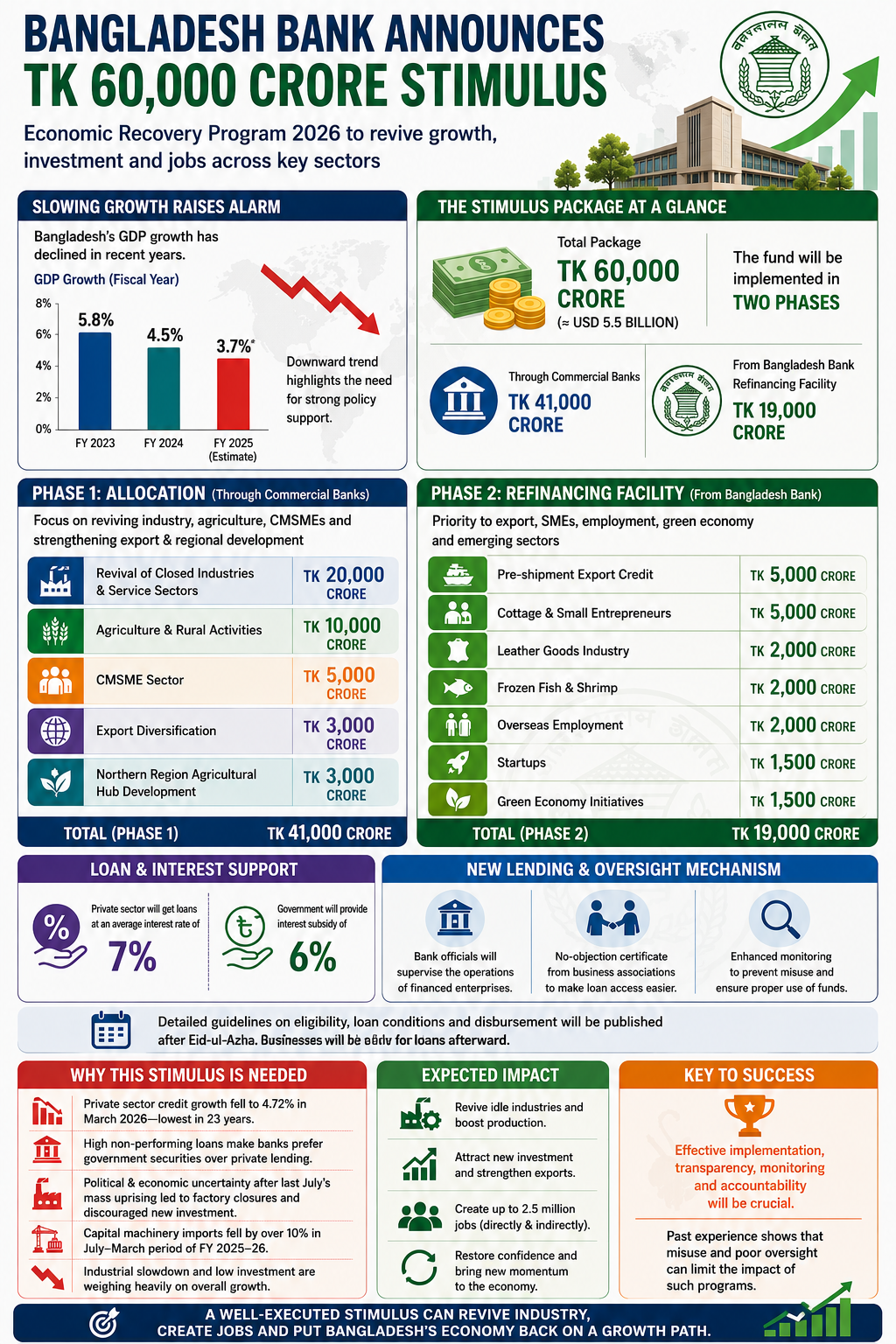
Slowing Growth Raises Alarm
Bangladesh’s economic growth has shown a consistent downward trend in recent years. GDP growth fell from 5.8 percent in fiscal year 2023 to an estimated 3.7 percent in fiscal year 2025, raising concerns among policymakers and investors alike. The latest stimulus aims to counter this decline by injecting liquidity and rebuilding confidence in the private sector.
Structure of the Package
The Tk 60,000 crore fund will be executed in two phases. Of the total, Tk 41,000 crore will be mobilized through commercial banks, while Tk 19,000 crore will come from refinancing facilities provided by the central bank.
In the first phase, the largest allocation—Tk 20,000 crore—has been earmarked for reopening and supporting closed industrial and service-sector enterprises. Agriculture and rural activities will receive Tk 10,000 crore, while CMSMEs will be allocated Tk 5,000 crore. Additional funding includes Tk 3,000 crore each for export diversification and the development of an agricultural hub in northern Bangladesh.
The second phase prioritizes export-oriented financing. This includes Tk 5,000 crore for pre-shipment export credit and another Tk 5,000 crore for cottage and small entrepreneurs. Separate allocations are also planned for leather goods, frozen fish and shrimp, overseas employment, startups, and green economy initiatives.
Loans under the program will be offered to private sector borrowers at an average interest rate of 7 percent, with the government providing a 6 percent interest subsidy to banks.
New Lending Oversight Mechanism
To ensure proper utilization of funds, Bangladesh Bank is proposing a new loan disbursement system. Under this approach, bank কর্মকর্তারা (officials) will directly supervise the operations of funded businesses. Additionally, enterprises receiving no-objection certificates from business associations will gain easier access to financing.
Officials say the enhanced monitoring framework is designed to prevent misuse, a problem that plagued previous stimulus programs. Detailed guidelines on eligibility, loan conditions, and disbursement procedures are currently being finalized and are expected to be released after Eid-ul-Azha.
Economists Urge Strong Governance
While the announcement has been welcomed as timely, economists stress that simply allocating funds will not guarantee results. Transparent loan distribution, strict monitoring, and accountability will be critical to ensuring effectiveness.
Past stimulus initiatives have often fallen short due to misallocation and weak oversight, limiting their impact on economic recovery. Analysts warn that without addressing these structural issues, the new package may face similar challenges.
Private Sector Struggles
The stimulus comes at a time when private sector credit growth has dropped to alarming levels. According to central bank data, private sector credit growth fell below 5 percent in March this year, reaching just 4.72 percent—the lowest in 23 years.
High levels of non-performing loans have made banks increasingly risk-averse, prompting them to favor government securities over private lending. Meanwhile, political and economic uncertainties following last July’s mass uprising have led to factory closures and discouraged new investment.
Investment and Imports Decline
The slowdown in investment has also affected imports. During the July–March period of the current fiscal year, imports of capital machinery declined by over 10 percent, reflecting reduced industrial activity and expansion plans.
Economists believe that revitalizing idle factories and encouraging fresh investment will be key to reversing the broader economic slowdown.
Industry leaders remain cautiously optimistic. Mahiuddin Rubel, former director of the Bangladesh Garment Manufacturers and Exporters Association (BGMEA), said coordinated support across sectors is urgently needed to counter declining growth.
তিনি (he) noted that effective implementation of the stimulus could boost productivity, attract new investment, and potentially create up to 2.5 million jobs, both directly and indirectly.
If executed properly, analysts say, the recovery program could help revive struggling industries and restore momentum to Bangladesh’s economy. However, its ultimate success will hinge on disciplined execution and robust governance.