DHAKA, BANGLADESH — Bangladesh’s current trade policies, characterized by anti-export bias and high protective tariffs, are causing a staggering financial loss of over $20 billion annually for domestic consumers. This loss accounts for more than 5% of the country’s total GDP, according to a report by the Policy Research Institute (PRI).
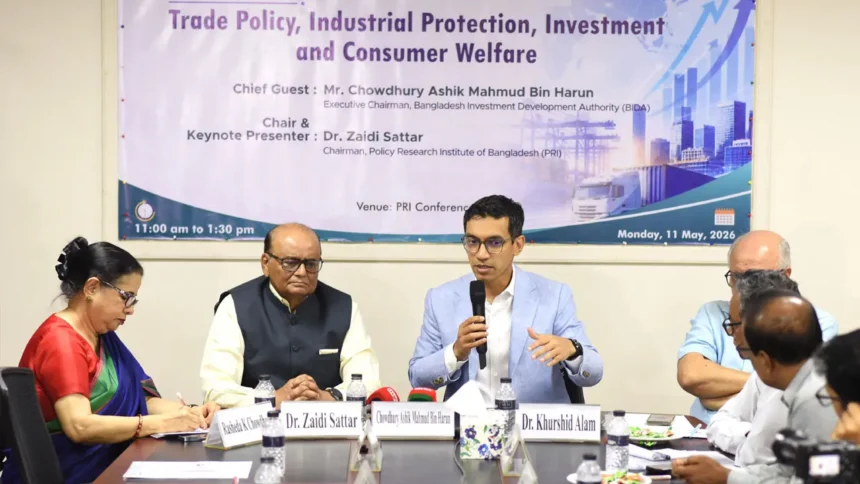
The findings were presented on Monday (May 11) during a roundtable discussion titled “Trade Policy, Industrial Protection, Investment Impact, and Consumer Welfare” held at the PRI office in Banani. Experts and business leaders at the event called for immediate and sweeping reforms to the nation’s trade and tariff structures to alleviate the burden on the public.
The High Cost of Protectionism
In his keynote presentation, Dr. Zaidi Sattar, Chairman of PRI, highlighted the sharp disparity between Bangladesh’s tariff rates and global standards. He noted that while the average tariff rate for lower-middle-income countries is around 7%, Bangladesh’s average stands at 28%—four times higher.
When additional “para-tariffs” are included, the effective tariff rate often climbs to 55%. As a result, Bangladeshi consumers are forced to pay approximately 50% more for goods compared to international market prices.
“Since 2022, the 40% devaluation of the Taka has already driven up the cost of imported goods,” Dr. Sattar explained. “On top of that, high tariff levels are severely eroding the purchasing power of the common man.”
“Trade Policy Dualism” Hindering Diversification
The PRI Chairman also pointed out a significant imbalance in the industrial policy known as “Trade Policy Dualism.” While the Ready-Made Garment (RMG) sector enjoys duty-free raw material imports, other potential export sectors remain stagnant due to high import duties on their inputs.
The report revealed a glaring gap in support:
-
Import-Substitute Industries: Receive approximately 28% protection.
-
Export Sectors (excluding RMG): Receive only about 7% in subsidies.
This imbalance makes it nearly impossible for non-RMG sectors to compete globally, stifling the country’s goal of export diversification.
Institutional Perspectives
Chowdhury Ashik Mahmud Bin Harun, Executive Chairman of the Bangladesh Investment Development Authority (BIDA), attended as the Chief Guest. He emphasized that protectionism cannot last forever. “Our goal should not be to protect industries indefinitely, but to help them stand on their own feet,” he stated, adding that the focus must shift from policy-making to effective implementation.
AHM Shafiquzzaman, President of the Consumers Association of Bangladesh (CAB), argued that policies protecting industries by restricting imports at the expense of consumer interests must be reconsidered. Meanwhile, Taskin Ahmed, President of DCCI, and former NBR member Md. Farid Uddin stressed the need for simplifying the tariff structure and improving coordination between government agencies.
Key Recommendations for Reform:
To address these economic challenges, the roundtable participants proposed several critical measures:
-
Swift Implementation: Fully execute the National Tariff Policy 2023.
-
Harmonization: Align trade policies with exchange rate policies to manage inflation.
-
Coordination: Strengthen cooperation between the NBR, Bangladesh Bank, and the Ministry of Commerce.
-
Gradual Reduction: Systematically lower tariff rates to meet global standards.
-
Consumer-Centric Policy: Shift the focus of trade policy to prioritize consumer welfare alongside export growth.