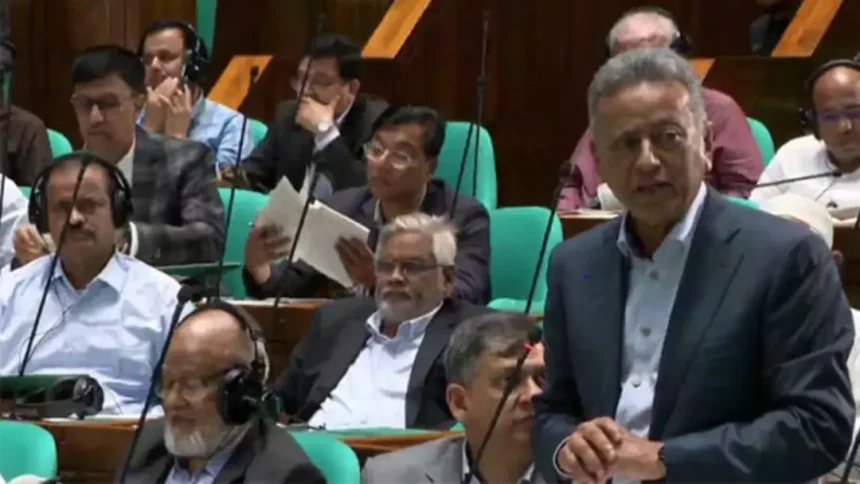
Finance Minister Amir Khosru Mahmud Chowdhury announced that the government’s primary objective is not merely achieving growth, but building a sustainable, transparent, and inclusive economy.
Delivering a statement under Rule 300 during the 13th day of the first session of the 13th National Parliament on Friday (April 10), the Minister outlined the fiscal challenges and strategic vision of the newly elected government. The session was presided over by Speaker Hafiz Uddin Ahmed.
Navigating Global Crises and Budgetary Pressures
The Finance Minister revealed that preparations for the FY2026-27 budget are underway amidst significant macroeconomic pressures. He noted that within just ten days of the government taking office, the Iran-Israel conflict erupted, doubling the international prices of fuel oil and LNG.
-
Subsidies: The government faces an additional BDT 36,000 crore in power and energy subsidies beyond the original budget allocation through March of the current fiscal year.
-
Reserves: This surge translates to approximately $3 billion in import payments, placing immense pressure on foreign exchange reserves.
-
Strategic Support: To mitigate the balance of payments crisis, the government is seeking additional “Budget Support” from international development partners.
Despite these global headwinds, the Minister emphasized that the government has maintained existing energy prices to protect citizens from further hardship, while urging the public to be more efficient in energy consumption.
A Vision for a “Trillion-Dollar Economy”
Finance Minister Chowdhury stated that the government is committed to transforming Bangladesh into a $1 trillion economy by 2034. This will be achieved through a dynamic development framework and strategic sectoral allocations.
Key Pillars of the Economic Strategy:
-
Inflation Control: Aiming to bring inflation down to 5-6% to ease the cost of living.
-
Revenue Reform: Modernizing and automating tax management to increase the Tax-to-GDP ratio to 15%, thereby reducing debt dependency.
-
Recovering Laundered Money: Active communication with international agencies has begun to bring back siphoned assets.
-
Investment Climate: Prioritizing the SME sector to boost real GDP and job creation.
-
Social Protection: Increasing spending on human development (education and health) and expanding social safety nets.
Financial Sector Governance and Reforms
The Minister highlighted a shift in capital formation strategy, moving the focus from the banking sector to the capital market.
-
Capital Market: To restore investor confidence, the Bangladesh Securities and Exchange Commission (BSEC) will be granted “true independence.” A special commission will be formed to investigate irregularities from the past 15 years, and strict legal action will be taken against market manipulators.
-
Market Diversification: The government plans to introduce corporate bonds, Sukuk, and Green Bonds.
-
Banking Sector: Legal frameworks for the Central Bank are being reformed to ensure good governance, aiming to return to the standards seen in FY2005-06.
Legacy and Commitment
Invoking the political heritage of the Bangladesh Nationalist Party (BNP), the Minister credited Shaheed President Ziaur Rahman for initiating multi-party democracy and economic progress, and Begum Khaleda Zia for modernizing the VAT system and industrializing the nation.
“We are determined to lead the economy toward a progressive and sustainable path based on transparency, truth, and accountability,” the Finance Minister concluded, expressing confidence in the Prime Minister’s visionary leadership.