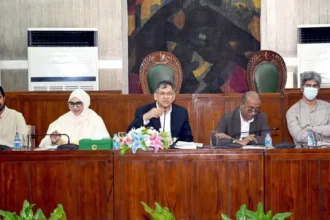
Finance Minister Amir Khosru Mahmud Chowdhury announced on Monday that Bangladesh has set an ambitious “mega-target” to become a $1 trillion economy by 2034. The announcement came during the ninth day of the first session of the 13th National Parliament.
Responding to a written query from Dhaka-18 MP S.M. Jahangir Hossain, the Finance Minister also shared updated figures on the nation’s standard of living, noting that the per capita income for the 2024-25 fiscal year stands at $2,769, according to the latest data from the Bangladesh Bureau of Statistics (BBS).
A Roadmap to a Trillion-Dollar Milestone
The Minister emphasized that the government is not merely aiming for growth but is focused on a structural transformation of the economy. To reach the trillion-dollar mark within the next eight years, the government has developed a specialized action plan prioritizing:
-
Economic Democratization: Ensuring growth benefits all levels of society.
-
Creative and Sports Economies: Tapping into new, non-traditional sectors for revenue and branding.
-
Investment & Employment: Massive scaling of industrial and service sectors.
Strategic Pillars for Growth
The Finance Minister outlined several key macroeconomic strategies currently being implemented to boost per capita income and ensure stability:
1. Employment and Productivity The government is placing “maximum importance” on job creation in the IT, agriculture-processing, and small entrepreneurship sectors to tackle unemployment and boost national output.
2. Supporting SMEs and Youth Special focus is being directed toward Small and Medium Enterprises (SMEs). The government is launching initiatives to simplify financing for women and young entrepreneurs, aiming to foster a more inclusive business environment.
3. Skilled Manpower and Remittances To increase the earning capacity of the population, the government is providing technical training aligned with both domestic and international labor market demands. Efforts are also underway to streamline legal remittance channels and diversify export products to strengthen foreign exchange reserves.
4. Industrialization By improving the “ease of doing business,” the government seeks to encourage private investment and ensure a steady flow of capital into manufacturing and production-oriented sectors.
Timeline for Implementation
Minister Chowdhury informed the House, presided over by Deputy Speaker Kaiser Kamal, that several of these initiatives are already being executed in the current 2025-26 fiscal year. Others will be rolled out through short, medium, and long-term phases.
“These integrated efforts will not only protect the purchasing power of our citizens but also build a solid foundation to achieve our 2034 milestone,” the Finance Minister stated.
The session highlighted the government’s commitment to a multi-sectoral approach—moving beyond traditional industries to ensure long-term macroeconomic resilience and a high-income future for the nation.