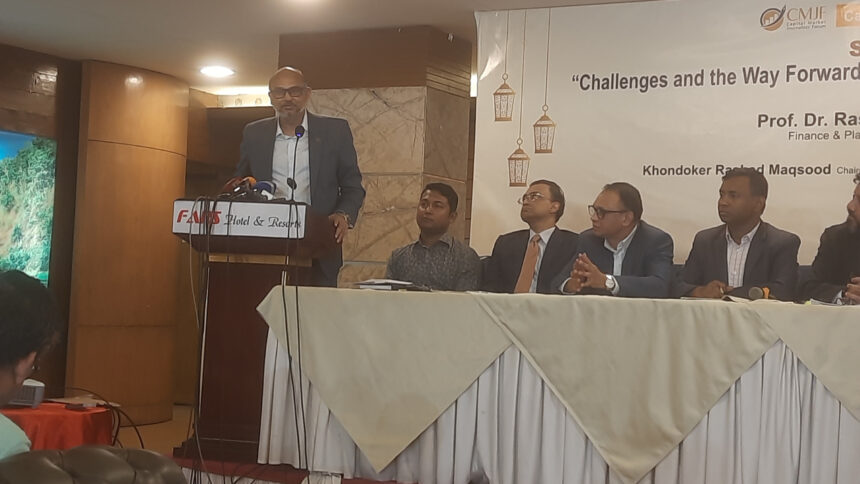
High-level policymakers and regulatory heads have called for a fundamental shift in Bangladesh’s economic model, urging a transition from a debt-reliant system to an investment-driven, ownership-based economy. Speaking at a high-profile seminar titled “Challenges and the Way Forward for the New Government in the Stock Market,” organized by the Capital Market Journalists’ Forum (CMJF) on Sunday, experts emphasized that a transparent and vibrant capital market is the backbone of sustainable industrialization.
Economic Democracy and Ownership
The Chief Guest of the event, Professor Dr. Rashed Al Mahmud Titumir, Economic and Planning Advisor to the Prime Minister, delivered a clarion call for structural change. “An economy reliant solely on consumption or debt can never be sustainable in the long run,” Dr. Titumir stated. “We aim to transform a debt-burdened society into an ownership-based one, where the general public acts as the true owners of the nation’s development.”
Highlighting the concept of “Economic Democratization,” the Advisor noted that the capital market is the only vehicle to ensure that the country’s services and wealth remain in the hands of its citizens. He attributed the current market stagnation to a fragile regulatory framework, pointing specifically to the lack of accountability among audit firms, credit rating agencies, and advocacy groups. Furthermore, he proposed the establishment of a dedicated ‘Islamic Stock Exchange,’ drawing inspiration from successful models in Malaysia and Indonesia.
Reform Over Incentives: The NBR’s Stance
In a candid assessment, Md. Abdur Rahman Khan, Chairman of the National Revenue Board (NBR), challenged the long-standing demand for tax incentives. “Incentives are not the ultimate solution. We have provided extensive tax breaks in the past, yet they yielded no lasting results,” he remarked.
The NBR Chairman argued that the current 7.5% tax gap between listed and non-listed companies is significant enough. According to him, the primary hurdle is a deep-seated “Crisis of Confidence.” He noted that investors have historically been cheated in banking, insurance, and particularly mutual funds—which should have been the safest investment vehicles.
“We must investigate why entrepreneurs prefer high-interest bank loans over the capital market. To spark an industrial revolution, the negative perception of the stock market among policymakers and the public must change,” Khan added, pledging NBR’s support provided it does not lead to revenue leakage.
Enforcement and New Legislation
Khandoker Rashed Maqsood, Chairman of the Bangladesh Securities and Exchange Commission (BSEC), detailed the commission’s aggressive stance against market manipulation. He revealed that BSEC has conducted 200 investigations and imposed fines totaling Tk 1,500 crore. While only Tk 5.20 crore has been recovered thus far, 16 allegations have been forwarded to the Anti-Corruption Commission (ACC), and four cases are currently in litigation.
“Our primary challenge is bringing quality companies to the market,” Maqsood stated. He announced that a new draft law has been prepared to facilitate the listing of large-scale, reputable companies. “Bangladesh has many excellent companies that are not yet listed. Bringing them in is essential for market growth.”
Structural Challenges vs. Tax Parity
During the keynote presentation, Md. Moniruzzaman, Senior Vice President of the DSE Brokers Association (DBA), highlighted why quality companies hesitate to go public. The increased transparency and accountability required for listing often act as a deterrent. While he advocated for corporate tax reductions to offset these “transparency costs,” others disagreed.
BSEC Commissioner Md. Saifuddin questioned the continued reliance on incentives. “We are 50 years into our independence; why must we still rely on incentives to sustain the market?” he asked. He suggested that the market must move away from its total dependence on equity and instead prioritize Fixed Income and Bond Markets to build long-term investor confidence.
The Path Forward
The seminar concluded with a consensus that the capital market must be rebranded from a “speculative hub” to the primary source of industrial financing. Speakers, including DSE Chairman Mominul Islam and CSE Chairman AKM Habibur Rahman, agreed that a combination of political will, regulatory transparency, and a rational tax structure is required to restore the market’s former glory.
As Bangladesh stands at a crossroads, the transition from a debt-shackled economy to one rooted in public ownership appears not just an option, but a necessity for the “New Government.”