In a move set to transform the country’s export landscape, Bangladesh and the United States have signed a historic Agreement on Reciprocal Trade (ART). The deal significantly slashes tariffs and provides a “golden ticket” for the Ready-Made Garment (RMG) sector: zero reciprocal duties on apparel manufactured using U.S.-sourced raw materials.
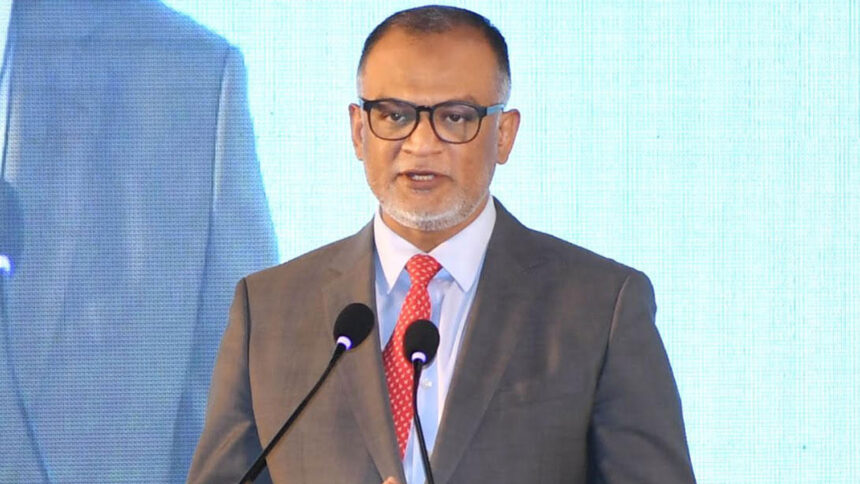
Speaking at a press conference at the Secretariat on Tuesday, Commerce Adviser Sk. Bashir Uddin hailed the agreement as a strategic victory that integrates Bangladesh into the global supply chain of the world’s largest economy.
Strategic Tariff Reductions
The agreement addresses the steep reciprocal tariffs imposed by the U.S. in early 2025. Through nine months of rigorous negotiation, the interim government successfully lowered the tariff barriers in stages:
With the existing base tariff of 15%, the total duty on most Bangladeshi products will now stand at 34%, down from a peak of 52%.
The “US Cotton” Advantage
The most significant breakthrough involves the use of American raw materials. Under the new terms, garments produced in Bangladesh using U.S. cotton or synthetic fibers will enjoy 0% reciprocal tariffs when exported back to the U.S. market.
“If we use U.S. cotton to manufacture garments, those products will enter the U.S. market with zero reciprocal duty,” explained Sk. Bashir Uddin. “Currently, 85–86% of our exports are RMG. Under this deal, that majority will see either zero or significantly reduced duties.”
Bangladesh currently produces only 2% of its required cotton locally, importing the remaining 98%. Shifting more of this sourcing to the U.S. is expected to reduce the $6 billion trade deficit with America while boosting export competitiveness.
Beyond Apparel: Pharmaceuticals and More
Commerce Secretary Mahbubur Rahman revealed that the U.S. has granted duty-free access to over 2,500 items under a special “Potential Tariff Adjustment for Partner Countries” list.
-
Pharmaceuticals: All medicine types and raw materials are now duty-free.
-
Diversified Goods: Plastic products, aircraft parts, and plywood board also receive preferential treatment.
A Flexible Partnership
Recognizing the political transition in Bangladesh, the Commerce Adviser noted that the agreement includes a withdrawal clause. If a future government finds the terms unsuitable, they can exit the deal with an “appropriate notice.”
The agreement also outlines increased commercial cooperation, including Bangladesh’s commitment to purchase $3.5 billion in U.S. agricultural products (wheat, soy, corn) and an estimated $15 billion in energy products over the next 15 years.