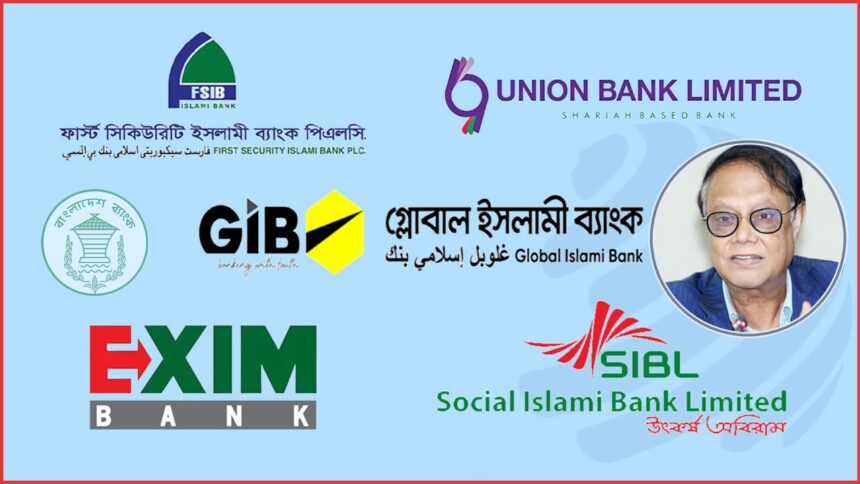
Customers of the five Islamic banks currently undergoing merger processes may begin receiving their deposit money as early as next week, according to Bangladesh Bank Governor Dr. Ahsan H. Mansur.
Speaking at an event at the Planning Commission in Agargaon on Monday (December 8), the Governor confirmed that under the deposit guarantee scheme, depositors will initially be refunded up to Tk 2 lakh.
The five banks in question are First Security Islami Bank, Global Islami Bank, Union Bank, Exim Bank, and Social Islami Bank.
Outlook on Profitability and Strict Policy
Governor Mansur expressed optimism regarding the future of the merged entities, stating that initial assessments suggest the new banks could become profitable within the first or second year. However, he emphasized a strict stance on financial discipline for struggling institutions.
“A ‘no dividend, no bonus’ policy is effectively in force for loss-making institutions,” the Governor declared.
He also highlighted that the Bangladesh Bank Order is under review to strengthen the central bank’s autonomy and accountability. Furthermore, bank officials whose issued loans turned into non-performing assets (defaulters) quickly will be brought under the ambit of accountability.
Strategic Defiance of IMF Advice on Forex
Addressing the foreign exchange market, Dr. Mansur revealed that the central bank did not fully adhere to the International Monetary Fund’s (IMF) advice to immediately float the dollar rate.
“If we had made the dollar price market-based before the market stabilized, the currency value could have skyrocketed like in Sri Lanka or Pakistan, potentially reaching Tk 190-200,” he explained. “We did not listen to them in all aspects. Many criticized this decision, but currently, our exchange rate is under control.”
Economic Indicators and Reforms
The Governor provided updates on the broader economic landscape and ongoing reforms:
-
Reserves: Foreign currency reserves have increased by approximately $10 billion from the low of $17 billion observed a year ago.
-
External Sector: The country’s external sector is in a positive position, with a surplus in the current account and positive growth in the financial account.
-
Reforms: The central bank has reconstituted the boards of 14 banks, initiated merger processes for five banks, and is proceeding with the liquidation of nine non-bank financial institutions (NBFIs).
Interest Rates and the “Uncomfortable Truth” of NPLs
Dr. Mansur ruled out any immediate reduction in interest rates. Although inflation has dropped from 12.5% to just above 8%, he argued that maintaining a slightly positive real interest rate is necessary.
Regarding Non-Performing Loans (NPLs), the Governor admitted to a harsh reality.
“The amount of defaulted loans had been underreported for a long time. After bringing transparency, it was found that the actual default rate is over 35%,” Dr. Mansur said. “While it is uncomfortable to admit, this is the reality. However, a significant reduction in defaulted loans will be visible by December.”