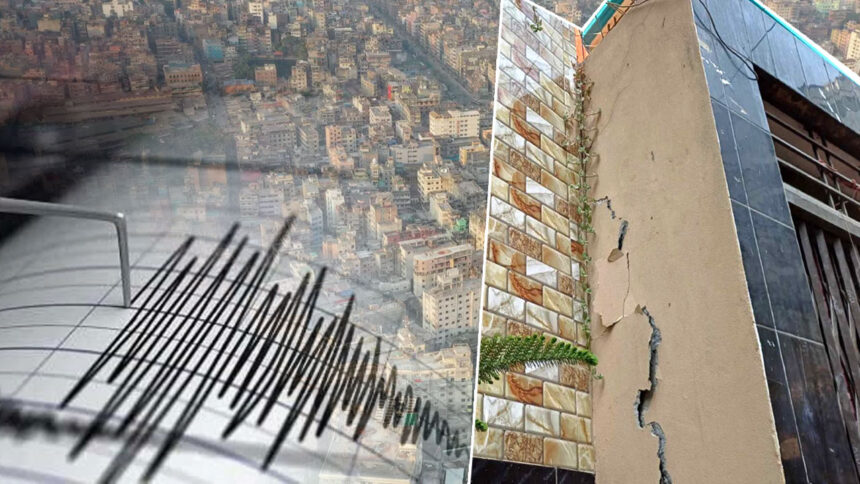
Experts and urban planners are sounding a grave alarm regarding Dhaka’s ability to withstand a major earthquake. Following a 5.7 magnitude tremor on Friday (Nov 21), concerns have intensified that the capital’s chaotic urbanization and widespread violation of building codes have turned the city into a potential “death trap.”
A survey conducted under the Capital Development Authority’s (RAJUK) Urban Resilience Project reveals a terrifying reality: if a 6.9 magnitude earthquake were to strike the nearby Madhupur Fault (Tangail), hundreds of thousands of buildings in Dhaka could collapse.
The Scale of the Crisis
The root of the danger lies in structural non-compliance. According to RAJUK data, there are approximately 2.145 million buildings in the capital.
-
95.36% of buildings constructed between 2006 and 2016 were built without approved designs or in violation of the National Building Code.
-
During that decade, while 95,000 structures were erected annually on average, RAJUK authorized only about 4,147 per year.
-
This year alone, RAJUK identified 3,500 illegal buildings and has begun eviction drives, particularly in areas like Basila, Dhaka Uddyan, and Keraniganj.
Why Dhaka is at High Risk
Experts have identified several compounding factors that make Dhaka uniquely vulnerable:
-
Soil Composition: A large portion of the city sits on loose, waterlogged alluvial soil. Strong tremors can cause soil liquefaction, leading to immediate building collapse.
-
Structural Integrity: Many buildings use sub-par rod and cement, lacking earthquake-resistant standards.
-
Infrastructure: Narrow streets and high population density impede rescue operations.
-
Lack of Evacuation Space: There is a severe shortage of open spaces where residents can seek safety during a disaster.
“Friday’s 5.7 magnitude quake was a warning—one of the smaller tremors that often precede a larger event. If a magnitude 7.0 earthquake occurs within 100km of Dhaka, the destruction will be massive, and casualties will be high.”
— Prof. Mehedi Ahmed Ansary, Department of Civil Engineering, BUET
Friday’s Tremor: A Reality Check
The 5.7 magnitude earthquake on Friday caused cracks in at least 14 buildings across the city. Dhaka District Relief and Rehabilitation Officer, Md. Salah Uddin-Al-Wadud, provided a breakdown of the affected locations:
| Area | No. of Damaged Buildings |
| Khilgaon | 2 |
| Malibagh Chowdhury Para | 1 |
| Armanitola | 1 |
| Sutrapur (Swamibagh) | 1 |
| Banani | 1 |
| Kalabagan | 1 |
| Bashundhara | 1 |
| Norda | 1 |
| South Banasree | 1 |
| Mohammadpur | 1 |
| Badda | 1 |
| Moghbazar (Madhubag) | 1 |
| Airport Area | 1 |
RAJUK Chairman Engineer Md. Riazul Islam confirmed that officials have been deployed to inspect these cracks and take necessary action.
Policy Shifts: Legalizing the Illegal?
Acknowledging the impossibility of demolishing millions of structures, RAJUK has drafted a new policy to address unauthorized buildings.
-
Fines: Buildings that generally follow the National Building Code but lack permits may be legalized by paying fines equivalent to 3 to 5 times the standard design approval fee.
-
Exceptions: Buildings that blatantly violate safety rules or encroach on government land will not be spared.
DAP Amendment & New Building Rules
The government has recently approved amendments to the Detailed Area Plan (DAP).
-
Zoning: Dhaka is now divided into 68 blocks (down from 275).
-
Height & Density: The Floor Area Ratio (FAR) has been increased, allowing 5-story buildings to potentially rise to 10 or 11 stories.
-
Incentives: Developers leaving more open space on a plot will be granted permission for greater building height.
Expert Recommendations
Urban planners like Prof. Dr. Adil Muhammad Khan of the Bangladesh Institute of Planners (BIP) argue that while laws like the Bangladesh National Building Code (BNBC 2020) exist, corruption and lack of accountability render them ineffective.
Immediate Actions Required:
-
Establish a Bangladesh Building Regulatory Authority (BBRA) to enforce codes strictly.
-
Ban all construction in low-lying wetlands and filled-up water bodies.
-
Identify and immediately evacuate the most dangerous buildings.
-
Ensure open spaces are preserved for emergency shelter.