Bangladesh’s Advisory Council has given its in-principle approval for the merger of five struggling private banks to create a new, single state-owned Sharia-based Islamic bank. The Council also approved amendments to modernize the Deposit Protection Act for the banking and insurance sectors.
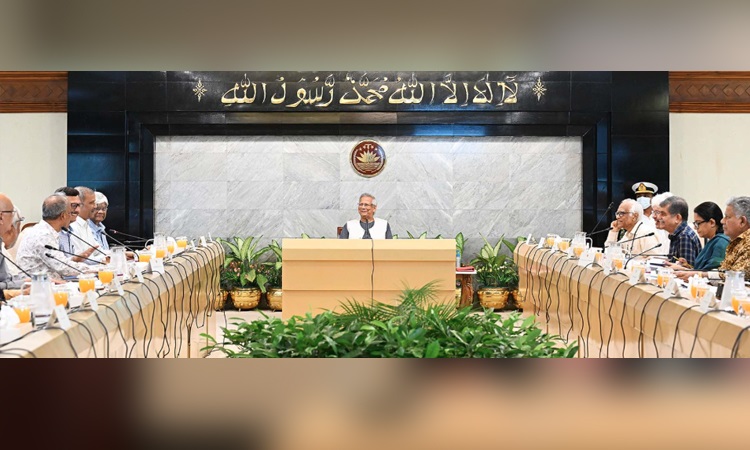
The decision was taken during an Advisory Council meeting chaired by Chief Adviser Professor Dr. Muhammad Yunus at the Chief Adviser’s Office in Tejgaon on Thursday.
The five banks slated for the merger process are: First Security Islami Bank PLC, Global Islami Bank PLC, Union Bank PLC, EXIM Bank PLC, and Social Islami Bank PLC.
Crisis Point: Liquidity and Capital Deficit
The Ministry of Finance was requested by the Bangladesh Bank to establish a state-owned Sharia-based Islamic bank through the merger (resolution process) of five of the six identified banks. This move comes after evaluation reports revealed that the aforementioned banks have massive non-performing loans (NPLs)/classified investments and significant capital shortfalls.
ICB Islamic Bank PLC was excluded from the resolution process due to an ongoing legal case in the High Court regarding its share ownership.
According to the Bangladesh Bank’s report, the financial condition of these banks has not improved despite receiving liquidity support for over a year; in fact, their liquidity crisis has deepened. The central bank noted that the magnitude of their capital deficit, NPL ratios, provision shortfalls, and liquidity crises has reached a point where they are unable to meet their obligations to depositors and creditors. This situation has led to a widespread crisis of public confidence in the banking sector, posing a threat to the country’s overall financial stability.
The Ministry of Finance considers it necessary to initiate the resolution process for these five crisis-ridden banks immediately under the Bank Resolution Ordinance, 2025. This is deemed essential to restore financial stability, bring back discipline in the banking sector, re-establish depositors’ confidence, and ensure a sustainable credit flow necessary for the nation’s economic growth, as the likelihood of these five banks returning to normal operations is minimal.
New Bank’s Capitalization Plan
The proposed new bank will be operated on a commercial and professional basis. The Bangladesh Bank report stated that the new bank will initially require an estimated BDT 35,000 crore (approx. $3.17 billion) in “Paid-up Capital” against an “Authorized Capital” of BDT 40,000 crore.
The preliminary capitalization plan involves a “bail-in” process, where BDT 15,000 crore of existing institutional deposits in the merging banks could be converted into capital. The remaining BDT 20,000 crore would be provided by the government as capital injection.