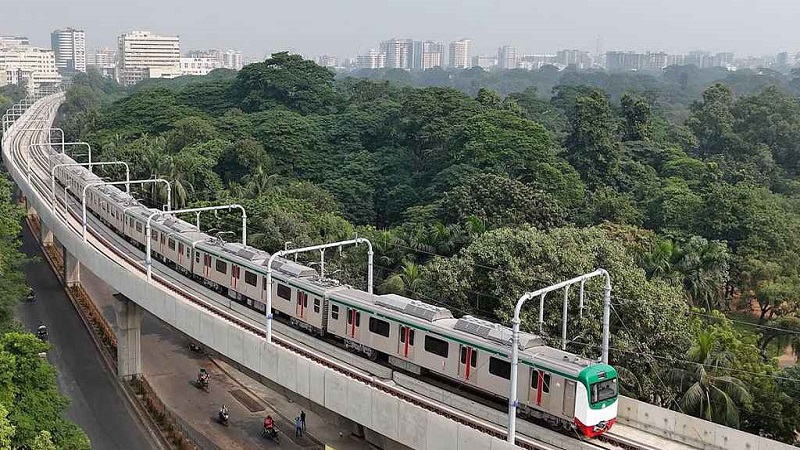
The cost of two ongoing metro rail projects in Dhaka has more than doubled compared to the government’s initial estimates. According to proposals from Japanese contractors, the expenses are projected to reach nearly Tk 2 trillion, whereas the government’s first estimation was around Tk 940 billion.
Due to this abnormal cost escalation, the government is now reviewing JICA’s (Japan International Cooperation Agency) proposal. At the same time, alternative options are being considered, including engaging companies from other countries if Japanese support cannot be secured.
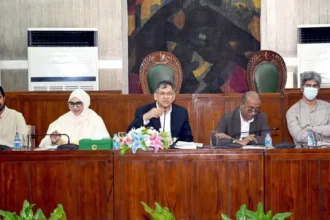
Recently, a delegation led by Economic Adviser Dr. Salehuddin Ahmed visited Japan and held meetings with both JICA and the Japanese government. Bangladesh requested that costs be brought down to a reasonable level. Upon returning, a high-level review committee was formed to reassess the expenditure.
The delegation also included Sheikh Moinuddin (Special Assistant to the Chief Adviser), ERD Secretary Md. Shahriar Kader Siddiqui, DMTC Managing Director Faruq Ahmed, and officials from different ministries.
According to the government’s initial plan:
- MRT Line-1 (Kamalapur to Airport, and Kuril to Purbachal) was estimated at Tk 525.61 billion.
- MRT Line-5 (Hemayetpur to Gabtoli, Mirpur, Gulshan, and Vatara) was estimated at Tk 412.61 billion.
Now, under the Japanese contractors’ proposal:
- Line-1’s cost has risen to around Tk 940 billion.
- Line-5’s cost has surged to Tk 1 trillion.
This means the cost per kilometer has exceeded Tk 30 billion.
Officials of DMTC, on condition of anonymity, said even repaying loans for the operational Line-6 (Uttara to Kamalapur) has been difficult. If new project costs rise further, the burden on the public will increase significantly. They noted that Japan-funded metro projects in other countries have cost much less.
Experts argue that the absence of competition has led to such inflated costs. Under JICA’s conditions, only Japanese companies are allowed to participate in tenders, enabling a small group of firms to form syndicates and quote excessively high prices.
Dr. Shamsul Hoque, transport expert at BUET, said:
“Spending Tk 30 billion per kilometer might set a world record. This is undoubtedly an overvalued project.”
He further added that JICA, under the guise of concessional loans, has imposed unfair conditions, which are harmful to Bangladesh’s interests.
On the issue, Dr. Salehuddin Ahmed said the depreciation of the Taka against the Dollar could reasonably raise costs by 40–50%, but the current proposal is far higher.
“We are negotiating with JICA for a fair cost. If they do not agree, we will consider alternatives with firms from other countries.”
However, some government officials pointed out that excluding JICA’s support might bring financial challenges, while taking on an overly expensive project would also be unsustainable.
Muhammad Faozul Kabir Khan, Adviser to the Ministry of Road Transport and Bridges, confirmed:
“We have already informed JICA that such a high-cost project is not feasible. A review is underway, and the final decision will be made after further discussions with Japan.”